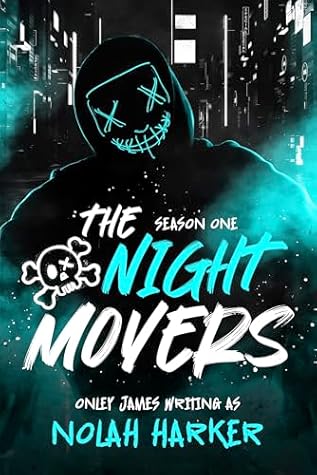
 | The Night Movers: Season One by Nolah Harker ★★★☆☆ Read: October 9, 2026 342 pages |
This book feels like watching a train wreck while eating popcorn and you can't look away — but make it MM, make it erotic, and throw in six tattooed alphas.
The Night Movers was my first why-choose where the central character is a man — one mouthy, cynical, fem presenting, nineteen-year-old omega surrounded by six dangerous alphas who are absolutely not what they seem. That flip alone kept me turning pages. The pack's cover operation is genuinely clever, the dystopian world is bleak, and the spice? Intense, filthy, and not shy about its kinks.
And the alphas. Diesel is the big cuddly bear of the pack — the mechanic with grease-stained hands who'd rather hold you through a heat than prove anything. He was my favorite from the moment he reached for Ridley. Steele is his opposite: blond, closed off, wearing asshole like a badge, calling omegas "inconvenient" with a straight face. You just know he's going to crack the hardest. Titus carries the weight of the whole pack on scarred shoulders, and the others — Sugar, Ryker, Jensen — have enough presence to intrigue, even if the book doesn't give them the page time they deserve.
But the execution didn't match the concept.
Everything is rushed. Ridley goes from trafficked stranger to deeply bonded in what feels like hours, and the emotional beats arrive before the story earns them. The worldbuilding comes in late info dumps — some of it critical, landing in the final chapters when I needed it from the start. I spent the first third confused about how this world works. And Ridley swings between fierce, scheming fighter and needy, whimpering puddle so fast it gave me whiplash, without ever wrestling with that split on the page. This felt like two books' worth of story crammed into one.
Heads up: this is marketed as book one, but it's set in an interconnected universe, after two other books. I went in blind and I think it shows, but I'm of the opinion that if a book is marketed as first in a series, I should be able to jump in the world without confusion. It also ends on an open cliffhanger with nothing resolved. Night Movers has been released since June 2025 and I haven't found a release date for book 2 as of October 2026, which feels like an awfully long wait.
On audio, Liam DiCosimo does a pretty decent job trying to maintain seven distinct voices — eight, really, because Ridley shifts into a whole different register when his omega kicks in. But with that many men in the mix, it was just too much for me to follow along with audio alone, so I grabbed the ebook to keep up.
Great premise, real potential, and a pack I wanted to love. It just needed more time and more polish.
Tropes: all MM why-choose · Omegaverse · Dystopian · Morally grey MMCs · Criminal underworld · Touch him and die · Possessive, protective pack · Special (magical) abilities · Missing sibling quest · fight club · Heat cycle
Trigger Warnings⚠️: human trafficking, violence and death, dubcon and somnophilia, degradation, breeding kink, omegaverse dynamics.
Thank you to Podium Audio for the audiobook. All opinions are my own.
The Night Movers was my first why-choose where the central character is a man — one mouthy, cynical, fem presenting, nineteen-year-old omega surrounded by six dangerous alphas who are absolutely not what they seem. That flip alone kept me turning pages. The pack's cover operation is genuinely clever, the dystopian world is bleak, and the spice? Intense, filthy, and not shy about its kinks.
And the alphas. Diesel is the big cuddly bear of the pack — the mechanic with grease-stained hands who'd rather hold you through a heat than prove anything. He was my favorite from the moment he reached for Ridley. Steele is his opposite: blond, closed off, wearing asshole like a badge, calling omegas "inconvenient" with a straight face. You just know he's going to crack the hardest. Titus carries the weight of the whole pack on scarred shoulders, and the others — Sugar, Ryker, Jensen — have enough presence to intrigue, even if the book doesn't give them the page time they deserve.
But the execution didn't match the concept.
Everything is rushed. Ridley goes from trafficked stranger to deeply bonded in what feels like hours, and the emotional beats arrive before the story earns them. The worldbuilding comes in late info dumps — some of it critical, landing in the final chapters when I needed it from the start. I spent the first third confused about how this world works. And Ridley swings between fierce, scheming fighter and needy, whimpering puddle so fast it gave me whiplash, without ever wrestling with that split on the page. This felt like two books' worth of story crammed into one.
Heads up: this is marketed as book one, but it's set in an interconnected universe, after two other books. I went in blind and I think it shows, but I'm of the opinion that if a book is marketed as first in a series, I should be able to jump in the world without confusion. It also ends on an open cliffhanger with nothing resolved. Night Movers has been released since June 2025 and I haven't found a release date for book 2 as of October 2026, which feels like an awfully long wait.
On audio, Liam DiCosimo does a pretty decent job trying to maintain seven distinct voices — eight, really, because Ridley shifts into a whole different register when his omega kicks in. But with that many men in the mix, it was just too much for me to follow along with audio alone, so I grabbed the ebook to keep up.
Great premise, real potential, and a pack I wanted to love. It just needed more time and more polish.
Tropes: all MM why-choose · Omegaverse · Dystopian · Morally grey MMCs · Criminal underworld · Touch him and die · Possessive, protective pack · Special (magical) abilities · Missing sibling quest · fight club · Heat cycle
Trigger Warnings⚠️: human trafficking, violence and death, dubcon and somnophilia, degradation, breeding kink, omegaverse dynamics.
Thank you to Podium Audio for the audiobook. All opinions are my own.
Track your own reading journey ✦
Discover Tynga Publishing Reading Journals



.jpg "Devoted Reviewer's Arc Journal review spread")